On goats and moa
Anyone planting in Central Otago will be familiar with the problems caused by invasive herbivores, particularly rabbits but also goats and deer.
Generally these problems are addressed through exclusion (fencing) and various forms of pest control. For mobs of goats in rough high country terrain in particular, this control sometimes takes the form of aerial shooting, which can be highly effective.
On a hike to Bush Creek near Arrowtown, where the efforts of Southern Lakes Sanctuary have smashed the local possum population, we spotted this sign advising of aerial shooting along the Coronet face, on which someone had written with sharpie “Goats are the new moa”. Although the inscription is ambiguous, we assume this was written by someone who holds the somewhat common belief among hunters that introduced herbivorous mammals (usually deer) are replacing moa, holding a similar ecological niche and thus should remain in the bush - particularly opposing poisoning operations.
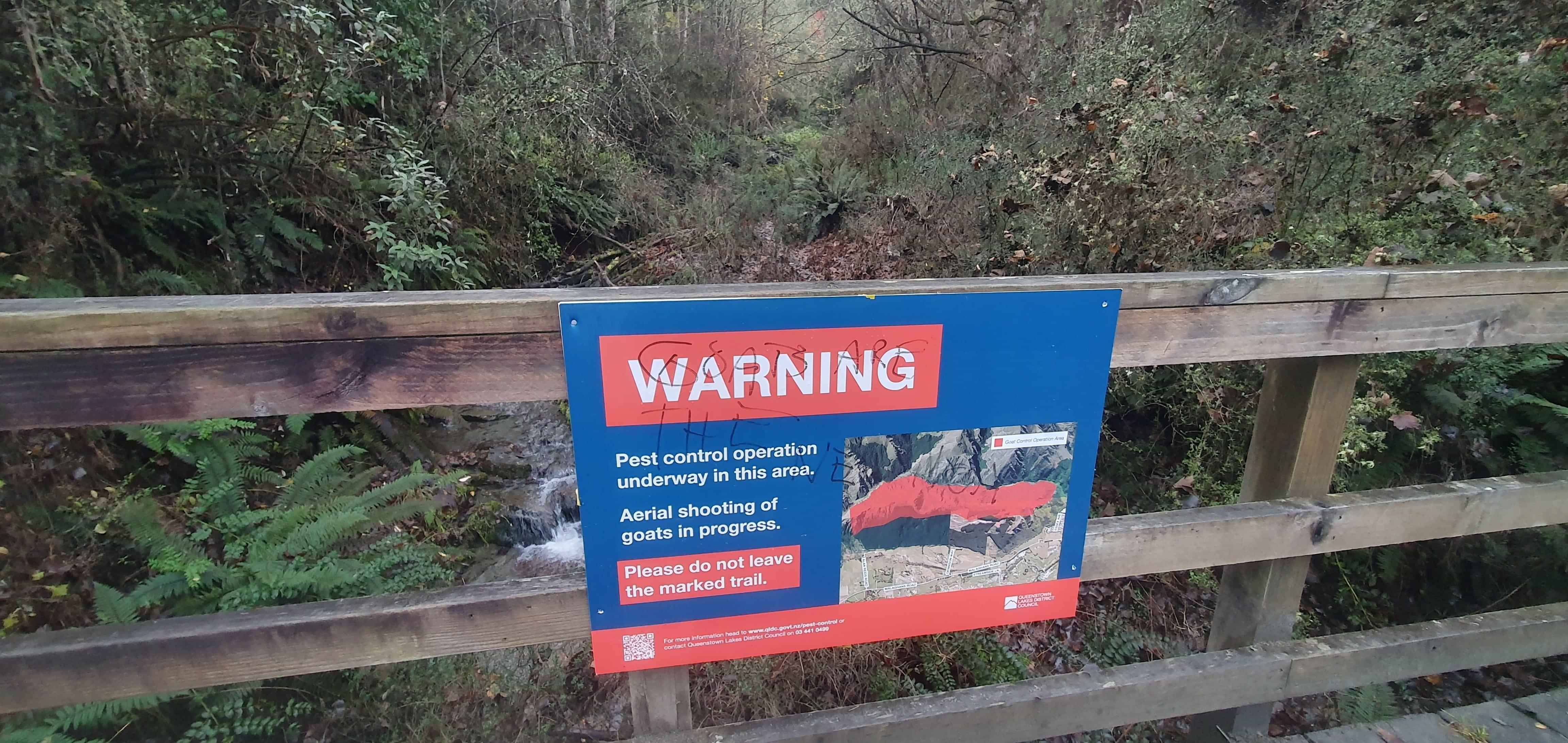
Above: Sign advising of goat control at Bush creek, above Arrowtown. Graffiti reads “Goats are the new moa”
“At a broad scale this seems like a sensible idea, as deer certainly do fill the niche of a forest understorey browser. Yet the comparison does not hold up under closer
scrutiny. Aside from the obvious mammal v. bird difference, deer are completely different animals to moa, from their teeth and hooves to their higher population densities and fecundity. Accordingly, their ecological impacts appear to far exceed those of moa. Any notion that deer and moa had comparable effects on native ecosystems has been comprehensively dismissed based on multiple lines of evidence, including an assessment of differences in soil compaction, a direct comparison of the content of moa coprolites and deer faeces, and pollen analysis of forest soil cores to examine vegetation responses to moa extinction”. (Wood et al, 2020)
Based on the direct evidence from over 140 scientific studies, the above quote from a paper on the diets of moa applies equally to goats as to deer - there are numerous qualitative and quantitative differences in the ecological impacts of mammals and moa.
The deleterious effect of invasive herbivores on native bush has been known since the early colonial period. To quote the writing of the botanist Walsh in 1893, who had a prescient understanding of the then undeveloped scientific field of ecology, “even the keenest sportsman (ed: deer shooter) would hardly be content to purchase his own gratification by the destruction of that forest which is the glory of his country and the birthright of the community at large … The forest has grown up through the course of the ages undisturbed by any four-footed enemy whatever. In its virgin state there is no grass, properly speaking, at all, while the undergrowth of ferns, shrubs, and seedling plants, once destroyed, can never be restored. And, moreover, the constituent portions are so dependent on each other for nourishment and protection that, once the balance has been disturbed, the entire growth rapidly suffers.”
(sourced via Whose high country? by Roberta McIntyre, pg 162)
Government sponsored culls of goats have long been recognised as necessary to protect native bush and began in the 1930s.
Why goats in particular have such a deleterious effect was summed up well by Cochrane in 1994: “… goats generally have a varied diet and are highly adaptive in terms of their diet. Goats have a strong tolerance to bitter tasting substances and possess a relatively larger capacity of the rumen and have a shorter retention of foodstuffs in the digestive tract. This allows consumption of a wide range of plants. Morphological adaptations, such as prehensile lips and the ability to stand on their rear legs while choosing food … also increase the goat's ability to forage. A high reproductive rate … and wide climatic tolerances add further to the ability of goats to be destructive. “
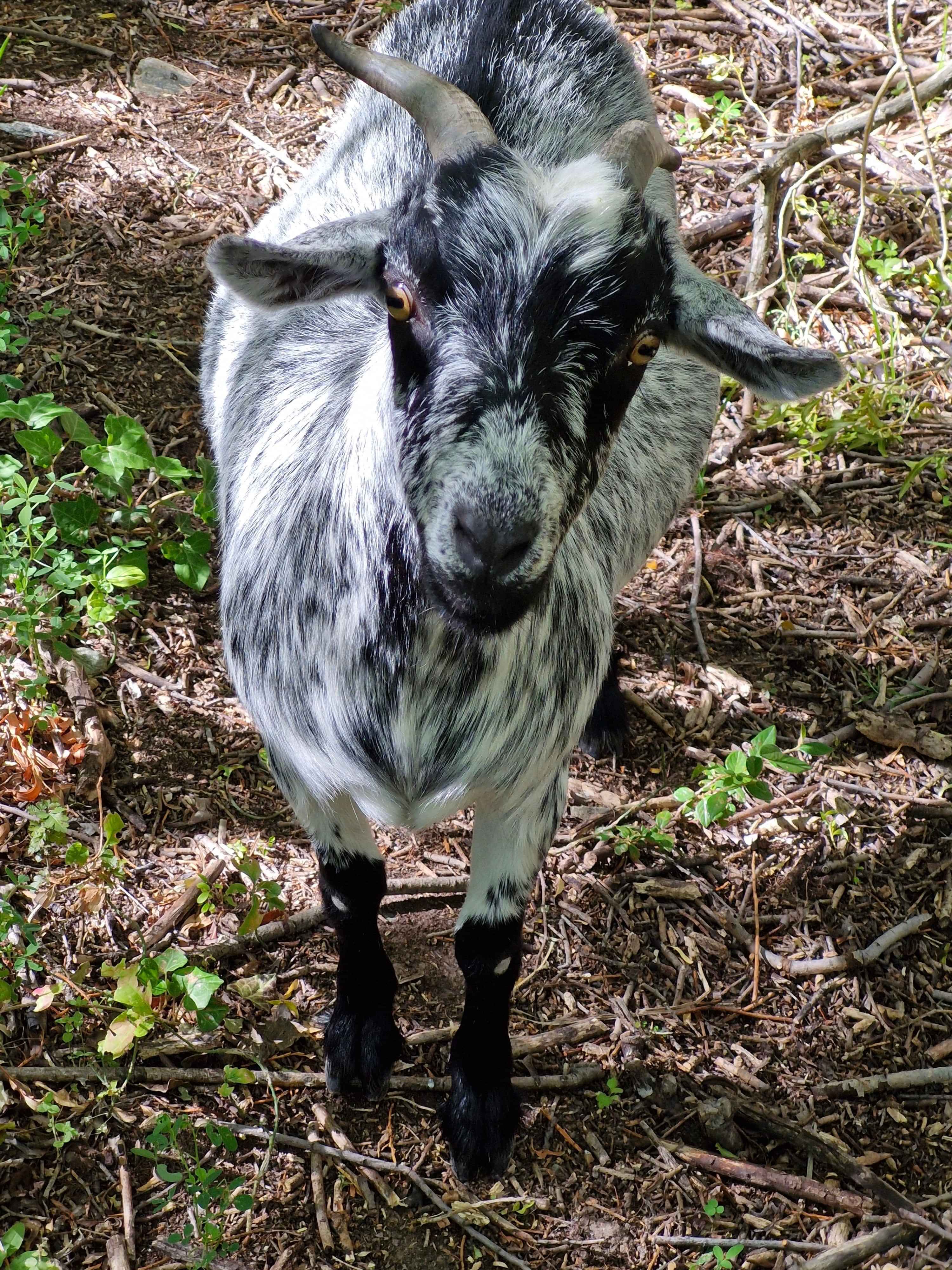
Above: A friendly goat in the Cromwell gorge. The feral goats of the Cromwell gorge, well controlled by shooting in recent months, may represent an older lineage than those of the Kawarau gorge, which seem to have more Angora and Boer goat genetics from escaped farm animals imported in the late 20th century.
Although in the scientific literature the foraging ecology of goats in NZ is more studied in bush ecosystems rather than high country, Cochrane did also observe “The major area of this vegetation type in the reserve is (silver tussock grassland). The boundary and extent of this vegetation type is extremely modified by fire. Although fire has
some control over the rate of reversion of parts of this vegetation type to shrub land, feral goat browsing is currently preventing reversion to shrub land. During the period of this study feral goats were regularly observed feeding in this vegetation type, especially on isolated Sophora microphylla and Coprosma propinqua shrubs.”
Due to their elective browsing of more palatable species (called the “forest ice cream” by DOC), the long term effect of goats on high country vegetation is the gradual removal of forest and tree species and their replacement with unpalatable shrubs and groundcovers. Through this process, goats can eventually convert forest to scrub, and perhaps scrub to grassland. Some farmers believe this process also works to prevent reversion by natural succession, eg preventing grassland from reverting to scrub. This is one reason why some high country farmers are happy to allow feral goat populations: the theory is that goats can eat plant species that sheep and cattle cannot, thus preventing their pasture from being overtaken by scrub and briar, and maintaining a useful mix of grasses for stock animals.
Let us examine a moa species more closely to make a direct comparison. Of the 4 or so species of moa that once called Central Otago home, the most similar to a goat is the moa pukepuke or upland moa, Megalapteryx didinus. This smaller moa is comparable to the goat in size and weight, around a metre tall and 30 kg. It’s range stretched around the Southern Alps and it’s hilly outer ranges from Nelson to Central Otago, but much like a goat it is considered a habitat generalist. This latter dry habitat led to the upland moa having the best preserved mummified specimens found, and as a result the anatomy of the upland moa can be well characterised.
The upland moa was “a specialist of steep and rocky habitats. With sharp claws and slender legs this agile moa may have specialised in feeding on plants growing in sites that were inaccessible to other moa species.” (Wood et al, 2020)
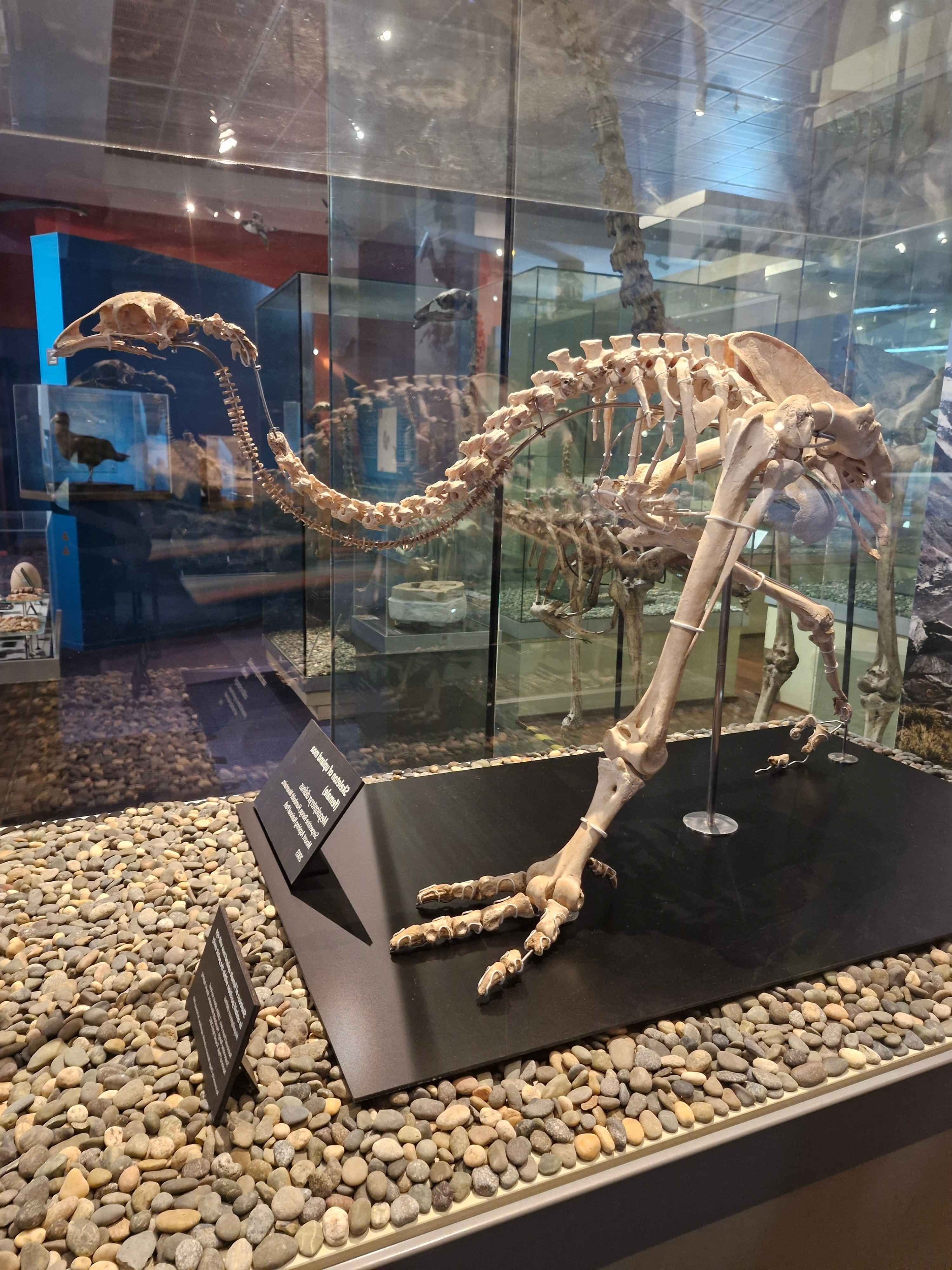
Above: A near complete upland moa skeleton on display in Tūhura Otago Museum in Dunedin. Note the very long articulated toes, postulated to be an adaptation to rough terrain
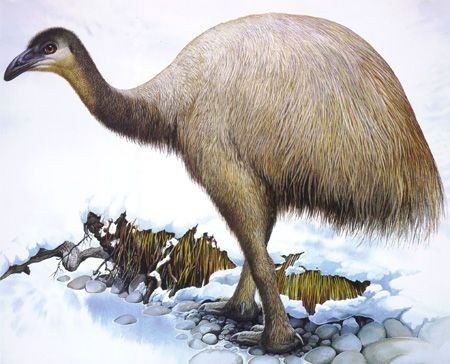
Above: Upland moa Megalapteryx didinus as imagined by Peter Schouten. Note the feathers extending all the way to the toes. Extant birds with adaptations to cold environments tend to have short, dense feathers, similar to those pictured here on the legs and neck.
The diet of the upland moa is known from direct evidence of coprolites and gizzard contents, examined microscopically and by DNA. It can also be inferred by anatomy.
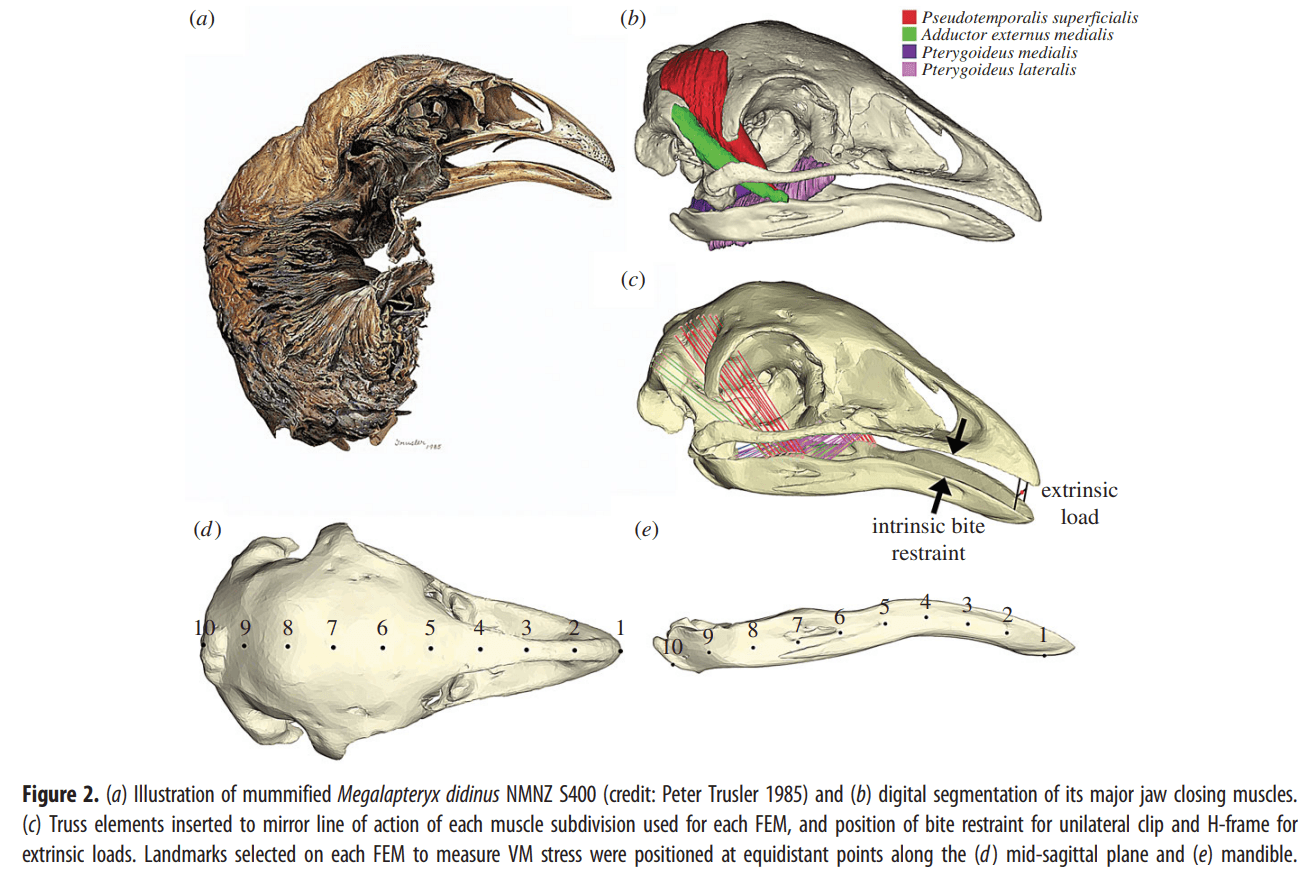
As shown above, the remarkably well preserved upland moa head and neck found in Earnscleugh Cave near Alexandra can be used for a detailed examination of the feeding anatomy of the moa. This model suggests that the upland moa’s beak and skull is “better adapted for specialized twisting motions, because of increased versatility and precision” and like all moa could easily clip thick twigs like secateurs. (Attard et al, 2016). Although goats and other mammals also have sharp incisors for clipping, their soft lips and long tongue creates a very different feeding style than the pulling and twisting of the moa - goats will rapidly strip shoots using a shearing motion enabled by their jaw morphology and repositioning them in their mouths to quickly strip biomass from plants. (Bond et al, 2004)
Perhaps this twisting motion could have been used for pulling out bits of tussock, not just the leaves but the rich stems. If so this method would have left the rest of the tussock intact and relatively easily able to recover - in contrast to ruminants and ungulates who clip the top down to the base. Slow growing alpine tussocks find it difficult to recover from this clipping.
Beyond the anatomical differences between mammals and moa in the feeding structures and digestion, their senses used to find food are also very different. Herbivorous mammals typically have poor eyesight, with almost no colour vision, while birds have extremely keen sight, usually with tetrachromatic colour vision that enables them to see more colours than us. On the other hand, mammals have amazing smell sense, largely absent in birds. These sensory differences greatly impact food choice - moa are thought to have been selective browsers, choosing the most palatable parts of the plant - unlike the indiscriminate goat.
So what did the upland moa eat? A full list of species associated with upland moa coprolites is listed pages 9-10 in Wood et al, 2020, but to summarise “Megalapteryx didinus had a widely varied diet, which included browsing of trees, shrubs and herbs… may have exhibited some seasonal diet variation, feeding in non-forested habitats most of year but within forest during winter. Bones have been found in mountainous regions that would have been snow-covered during winter, suggesting the species may have had seasonal altitudinal migration, from subalpine herbfields in spring/summer to valley forests in autumn/winter”.
As the pre-settlement vegetation of the South Island was so different from nowadays, making a direct comparison to goat diet is not very informative, but it is worth noting that the herbfields of Central Otago that comprised a major food source for upland moa no longer exist, having been destroyed by sheep grazing and fire in the early colonial period. These herbfield plant species that were extremely abundant are now rare.
Of course, moa and NZ native plants co-evolved for millions of years and are thus ecologically entwined. The colour and biochemistry of many NZ plants is likely an evolutionary defense against moa - instead of common plant defenses against mammalian herbivores like spines, which do not bother birds. The theory that NZ’s large amount of divaricating plants, many of which are the high country shrubs that we grow, is the result of co-evolution with moa has been around for decades and is well supported by evidence. Interestingly, this “ratite-resistant” evolutionary path has made these plants especially poorly suited to resisting mammalian grazing. “Our experimental evidence suggests that in New Zealand woody species without the ratite-resistant strategy would have been disadvantaged relative to ratite-resistant plants. Extinction of the moas might have triggered ecological release of broadleaved plant species which could out compete ratite-resistant species because of their faster growing, undefended shoots. Ratite-resistant plants suffer an additional burden because their costly allocation to structural defences is useless against invasive mammal browsers.” (Bond et al, 2004)
Herbivory was the major ecosystem process the moa were involved in, but moa also played a role in other ecosystem processes such as seed and nutrient dispersal. There is some evidence that mammal dung has partially replaced some of the functions of moa dung in these regards (Wood et al, 2011).
So overall, goats are not the new moa in an ecological sense, though both have had a transformative effect on the flora of NZ. However, there is one notable similarity: both were valuable food species for early settlers. Captain Cook introduced the first goats to Aotearoa, both mainland and off-shore, for purposes of creating a food larder that could be accessed in later visits. The value of moa as a food source for early Māori was immense, to the degree that entire societies were built around moa hunting.
If goats are not the new moa, then what could be? The (scientifically unproven) moa de-extinction projects notwithstanding, living large birds like emu have been put forward as an option “Visions of extant large ratite species such as (emu or ostrich), being introduced to New Zealand to fill the ecological niches of moa … are also misguided. Again, while these species may perform some of the seed dispersal once provided by moa, they cannot fulfil the role of a large avian tree and shrub browser that is now missing from New Zealand ecosystems. Differences in feeding capabilities means that extant large ratites could not consume enough nutrition to survive if feeding on many of the divaricating understorey shrubs once consumed by moa.” (Wood et al, 2020)
Sadly, there is no new moa.